Heavy Equipment Maintenance: 36 Technicians Begin Training at INPP Haut-Katanga — A Structural Breakthrough for Skills Development
INPP in Haut-Katanga has launched the DRC’s first nationally structured training programme in heavy equipment maintenance under the Support to Training and Qualified Employment Project (PAFEQ).
- July 07, 2026
- By Pacome Bagula
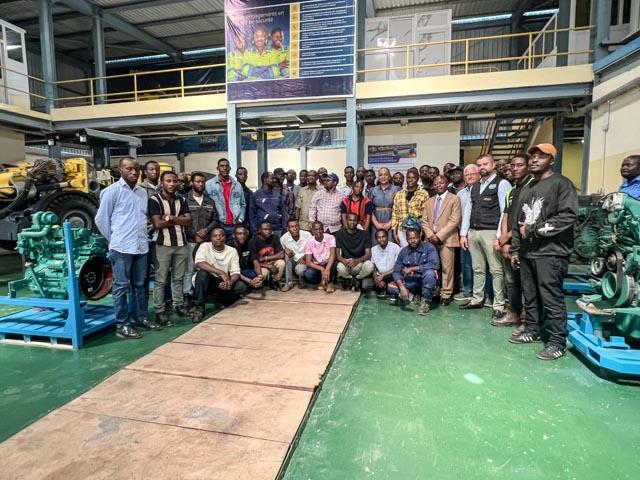
The Institut National de Préparation Professionnelle (INPP) in Haut-Katanga has launched the Democratic Republic of the Congo’s first nationally structured training programme in heavy equipment maintenance under the Support to Training and Qualified Employment Project (PAFEQ). Thirty-six job seekers, including three women, have entered a six-month, industry-aligned curriculum targeting critical workforce gaps in mining, transport, and construction.
A Launch Aligned with Systemic Transformation Objectives
The official inauguration, led by Jean-Pierre Nkulu, Technical Deputy Director of INPP Haut-Katanga representing Provincial Director Joël Mokomba Mata, consolidated public institutions and private sector stakeholders within a unified operational framework. The intervention emphasized execution discipline, training quality assurance, and outcome accountability.
Nkulu positioned the initiative as a structural inflection point: a first-of-its-kind programme at INPP, anchored in a public-private delivery model and backed by rigorous candidate selection mechanisms. The initiative signals a transition from supply-driven training to demand-driven workforce development.
“Today, we are witnessing the fruits of the PAFEQ project and this public-private partnership. The selected candidates underwent screening tests to enroll in a heavy equipment maintenance program here at INPP — a first for our institution. This is an innovation we must embrace and build upon.” — Jean-Pierre Nkulu, Technical Deputy Director, INPP Haut Katanga
Raef Melayeh, PAFEQ Project Coordinator, underscored the operational maturity of the partnership ecosystem and the readiness of implementation mechanisms now transitioning from design to scaled delivery.

Private Sector Integration: From Participation to Pipeline Structuring
Private sector engagement is embedded as a core execution pillar rather than peripheral support. Industry actors are directly shaping employability outcomes.
Willy Nkulu, representing Mulykap, framed the programme as a talent pipeline with immediate absorption potential, explicitly linking training performance to internship opportunities. This introduces competitive performance dynamics and reinforces merit-based access to employment.
“We are a developing country. We need skilled technicians. I ask you to commit fully to this program. Our company is prepared to welcome the top performers among you for upcoming internships.” — Willy Nkulu, Mulykap
SMT DRC, operationalized its contribution through provision of compliant technical equipment and co-investment in instructor capacity. This dual intervention ensures alignment with international maintenance standards while reinforcing local pedagogical capability.
Carine Nanikian Sombola highlighted gender inclusion as a strategic lever, not a symbolic gesture—positioning female participation within broader sector competitiveness and workforce diversification imperatives.
“SMT, as Volvo’s authorized dealer in the DRC, contributed to this training program by providing equipment that meets the required standards and by supporting instructor training. I applaud the participation of women, and I wish all of you every success.” — Carine Nanikian Sombola, HR Director Katanga, SMT DRC
Infrastructure and Pedagogical Assets: Tangible System Upgrades
The guided visit of the training workshop, led by the Head of the Automotive Mechanics Department, demonstrated concrete capital investments under PAFEQ. These include upgraded facilities, modernized equipment, and structured learning environments aligned with industry specifications.
These assets are not standalone improvements but components of a broader Centre of Excellence architecture currently being deployed in Lubumbashi and Kolwezi.

PAFEQ: Market-Driven Skills Engineering
Implemented by United Nations Industrial Development Organization in partnership with the Government of the DRC and funded by Sweden, PAFEQ addresses a quantified labour deficit exceeding several thousand technical positions annually in mining regions.
The programme architecture integrates:
- Competency-based training frameworks
- Standardized certification systems
- Industry-validated curricula
- Direct employer interface mechanisms
The six-month training cycle culminates in company-administered admission tests, effectively outsourcing final validation to employers. This reverses traditional certification logic by prioritizing labour market acceptance over institutional issuance.
A Replicable Model with Immediate Sector Signalling Effects
INPP Haut-Katanga is positioning itself as a national reference point for specialized technical training. The first cohort of certified heavy equipment maintenance technicians will enter the labour market within six months, setting a precedent for competency standards in the extractive and infrastructure sectors.
This initiative establishes a replicable model characterized by:
- Integrated public-private governance
- Demand-driven curriculum design
- Embedded employability pathways
- Gender inclusion targets within technical trades
The programme functions as both a training intervention and a systemic prototype for vocational transformation in the DRC.