From Chalkboard to Creativity: How Hands-On STEM Teaching is Transforming Learning for Young Students in Liberia
UNIDO's Youth Rising Project is equipping teachers with new approachs to teach science, technology, engineering and mathematics (STEM) in primary schools, nuturing a new generation of learners
- July 14, 2026
- By T Mark Korpu
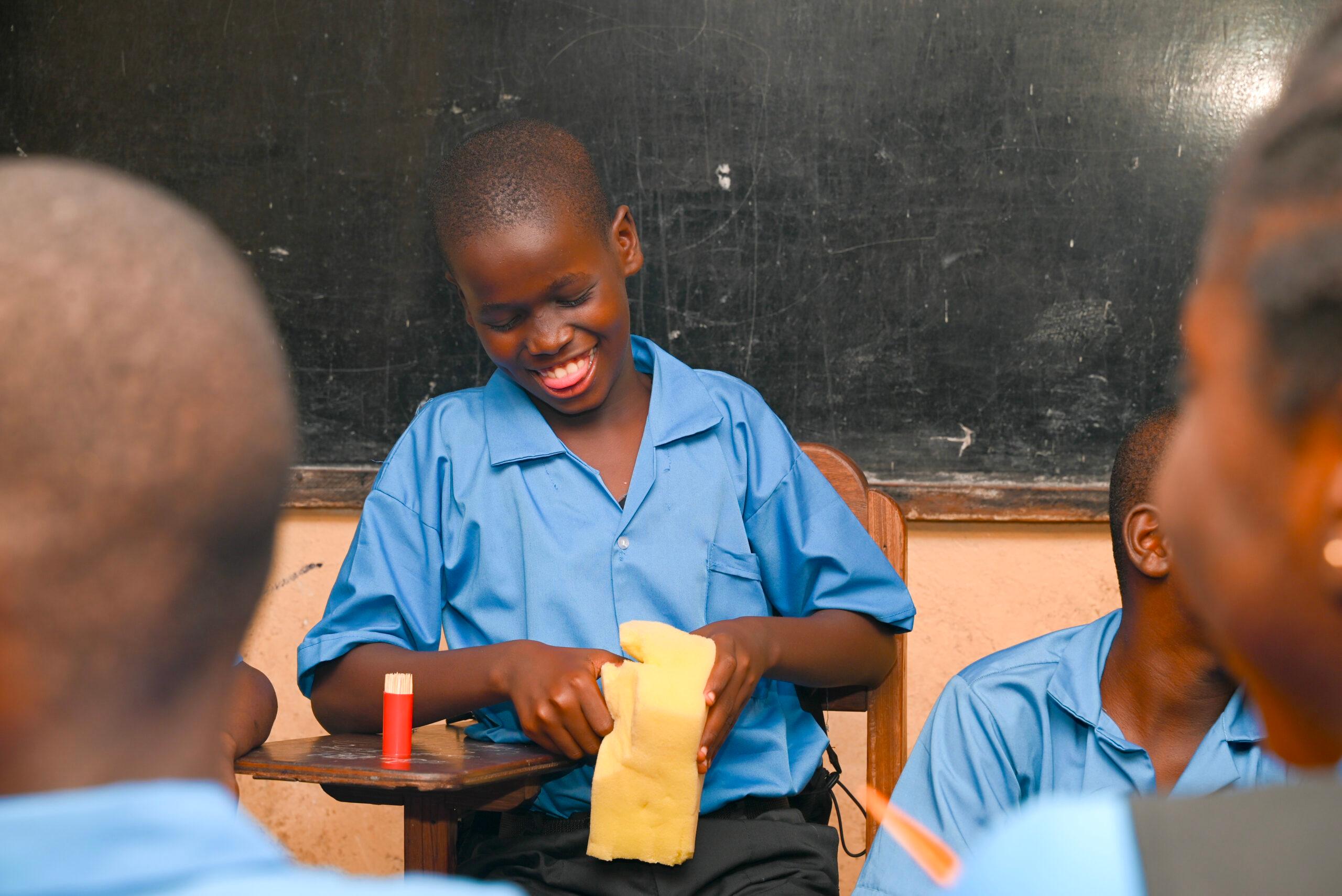
In a lively classroom filled with laughter, shapes, and curious young minds, learning mathematics no longer begins and ends with chalk on a blackboard. Instead, it now comes alive through sponges, posters, circles, and hands-on activities that make complex concepts easier for children to understand.
For fifth-grade student Amadou T. Sow, the difference is clear. “Before, the teacher used to stand and write on the board, and we would just copy,” Amadou recalled with excitement. “But now, we use things around us to learn. We can use sponge and other materials to understand math. Today we learned about triangles and squares, and I felt very good. I’m enjoying it.”
 Amadou is one of many students benefiting from a new approach to teaching science, technology, engineering and mathematics (STEM) in primary schools under the Youth Rising Project, funded by the European Union and the Government of Sweden, and implemented by UNIDO in partnership with the Practical Education Network (PEN).
The initiative is equipping teachers with practical, learner-centered methods that move beyond traditional chalk-and-talk instruction. Through specialized STEM training, teachers are learning how to turn everyday, low-cost materials into powerful teaching tools, making lessons more interactive, inclusive and memorable for students.
For Ernest Z. Brooks, a primary school teacher who participated in the training, the change has been immediate and visible in the classroom. “When we went for the workshop conducted by Practical Education Network, one of the first things we were taught was how to use hands-on materials in teaching,” the teacher explained. “When I came back, I realized that too much writing on the board was not helping the students as much as it should. But when you apply practical materials that are affordable and easy to find you are able to help the children understand better.”
Armed with new skills from the training, Ernest began redesigning lessons to make them more engaging. Instead of simply writing abstract concepts on the board, the teacher now uses visual aids and physical demonstrations to teach topics such as sets, shapes and polygons.
“For example, when I teach sets, I divide a circle into parts so the students can see Set A, Set B and Set C,” the teacher said. “Then I place the elements inside each set. We also used this same approach for polygons. Sometimes children do not understand what polygons are when you only write the word on the blackboard. But when they are playing, touching and doing the activity themselves, they understand the lesson much faster.”
The results have been remarkable. Ernest says the new methods have not only improved student participation and understanding but have also made classroom time more productive.
“One of the new methods I introduced in my classroom is cutting down the time factor,” the teacher noted. “Now I can teach about two topics within a 45-minute period, even with a class of up to 60 students. It has helped me a lot as a teacher.”
For students, the impact goes beyond improved comprehension. The new approach has transformed the atmosphere of the classroom from one of passive note-taking to active discovery.
“Before, the teacher would just write on the blackboard,” Amadou said. “But now we play around things, we learn together, and it feels like we are playing while learning.”
That sense of joy and curiosity is exactly what the STEM training under the Youth Rising aims to inspire: a generation of learners who are not intimidated by mathematics and science, but excited by them and would lead them to TVET.
By helping teachers use simple, low-cost materials to explain concepts in practical ways,

the project is making quality STEM education more accessible in primary schools, especially in environments where resources are limited. It is also strengthening teachers’ confidence and capacity to deliver lessons that are more interactive, student-centered and effective.
For Josephine F. Keita, the lessons are already leaving a lasting impression not only on what she learns, but on what she hopes to do with that knowledge.
“I want to learn so I can teach other people, just the way they teach us,” he said.
Her words capture the deeper promise of the Youth Rising Project: that by empowering teachers today, Liberia is nurturing a new generation of young learners who will one day pass on knowledge, confidence and opportunity to others.
As classrooms across the country continue to embrace practical STEM learning, stories like Amadou’s and Josephine’s offer a glimpse into a future where education is no longer just about memorizing lessons from a board, but about discovering, creating and learning by doing.